
Let me ask you something.
When was the last time you trusted an ad more than a friend’s recommendation?
Probably never, right?
That’s exactly why earned content matters — and why, as a digital marketer, it’s something you need to understand deeply, not just as a concept, but as a strategy you can actually build around.
So let’s break it down in plain terms.
The Three Buckets of Content (A Quick Refresher)
Before we dive into earned content specifically, it helps to understand where it sits in the bigger picture.
In digital marketing, content generally falls into three categories:
* Owned content is what you create and fully control — your blog posts, your social media profiles, your email newsletters, your website copy. You own it, you publish it, you manage it.
* Paid content is what you pay to distribute — Google ads, Facebook sponsored posts, influencer deals, sponsored content placements. You control the message, but you’re renting the audience.
* Earned content is everything else. It’s the coverage, the mentions, the shares, the reviews, the word-of-mouth — that you didn’t pay for and didn’t directly create. Someone else did it, for you, because they genuinely wanted to.
That last part is what makes earned content so powerful.
What Is Earned Media?
You’ve probably heard the term earned media used almost interchangeably with earned content — and for good reason. They’re closely related, but worth distinguishing.
Earned media refers specifically to the media coverage and exposure your brand receives without paying for it. Think press mentions, journalist features, podcast appearances, news articles, and editorial shoutouts. It’s the PR side of the earned equation.
When a well-known marketing publication writes about your agency, or a journalist quotes you as an industry voice — that’s earned media. You didn’t buy a sponsored slot. You earned the coverage because you had something worth covering.
Earned media is one of the most credible forms of visibility a brand can get, precisely because it comes with an implicit third-party endorsement. A reporter chose to write about you. An editor approved it. That carries weight that a paid ad placement simply cannot replicate.
What Is Shared Media?
Now here’s a term that doesn’t get talked about nearly enough: shared media.
Shared media is content that lives on platforms you don’t own — primarily social media — and spreads through organic sharing, engagement, and community participation. It sits at the intersection of earned and owned content, which is why some marketers call it the “fourth pillar” of the PESO model (Paid, Earned, Shared, Owned).
When someone reposts your LinkedIn article to their network, when a client shares your case study in a Facebook group, when a tweet of yours gets picked up and quoted by someone with a large following — that’s shared media.
What makes shared media distinct is the amplification factor. You may have created the original content (making it owned), but the moment someone else shares it to their audience, it becomes shared media. The reach multiplies. The credibility increases. And you didn’t spend a cent to make it happen.
In today’s social-first world, shared media is often the bridge between your owned content and earned media. A blog post that gets widely shared eventually lands in front of journalists, podcasters, and industry voices — which then generates earned media. The cycle feeds itself.
So What Exactly Is Earned Content?
Earned content is any content about your brand, product, or service that’s created and shared organically by people outside your organization — without you paying for it.
Think about it this way: when a journalist writes a feature about your agency, that’s earned. When a happy client posts about you on LinkedIn and their network starts sharing it, that’s earned. When someone leaves you a glowing five-star review on Google, that’s earned. When a popular marketing newsletter mentions your tool as a go-to resource, that’s earned.
You didn’t create it. You didn’t pay for it. But it happened — because you did something worth talking about.
Why Earned Content Hits Different
Here’s the thing about earned content that paid and owned content can never quite replicate: trust.
People are skeptical of ads. They skim past sponsored posts. They tune out branded messages. But when a real person — a customer, a peer, a journalist — says something good about your brand? That lands differently.
According to Nielsen’s research on consumer trust, recommendations from people they know and online consumer opinions are consistently among the most trusted forms of advertising globally. Paid ads? They rank near the bottom.
Earned content also has a compounding effect. A single well-placed media mention can drive referral traffic for months. A viral customer post can introduce you to thousands of people you’d never have reached through your own channels. And unlike a paid campaign that stops delivering the moment you stop spending, earned content keeps working long after it’s published.
Examples of Earned Content in the Wild
Let’s make this concrete. Earned content shows up in a lot of forms:
Press and media coverage — A tech blog writes about your new service offering. A marketing publication quotes you as an industry expert. A podcast invites you on to share your insights.
Social shares and mentions — A client posts your case study on their LinkedIn. Someone screenshots your tweet and reposts it with their commentary. A micro-influencer in your niche tags you in a story.
Online reviews and ratings — A client leaves a detailed Google review. Someone on Reddit recommends your agency in a thread about finding digital marketers. A G2 or Clutch profile gets a new five-star rating.
User-generated content (UGC) — Customers sharing their results after working with you. Screenshots of wins they achieved. Testimonials posted on their own platforms.
Backlinks and citations — Other websites linking to your blog posts because they found your content genuinely useful. This one also has direct SEO benefits.
Each of these is earned. And each of them carries weight that money alone can’t buy.
How Earned Media, Shared Media, and Earned Content Work Together
This is where it gets really interesting for marketers.
Think of these three as a flywheel:
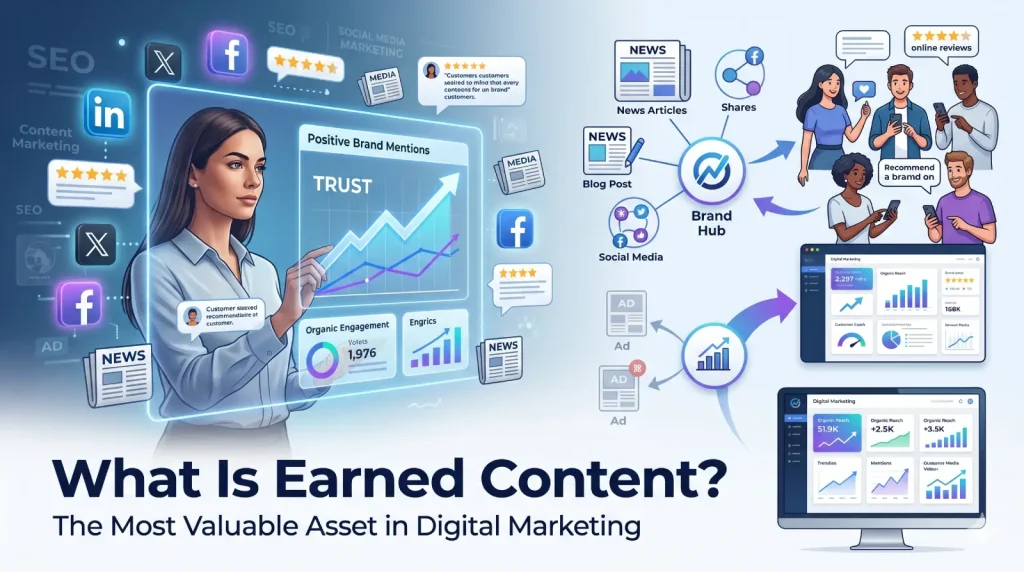
You create owned content — a well-researched blog post, a bold opinion piece, an original data study. Someone finds it valuable and shares it on their social channels. That’s shared media kicking in. The post gains traction, reaches a journalist or newsletter curator, and suddenly you’re featured in a roundup or quoted in an article. That’s earned media.
Meanwhile, all the social chatter and press coverage feeds back into your brand’s credibility, which makes people more likely to share your next piece of content — and the cycle continues.
None of these pillars work as well in isolation. The brands that win at content marketing are the ones who understand how owned, earned, and shared media amplify each other — and build their strategy accordingly.
How Do You Actually “Earn” It?
This is where a lot of brands get confused. They hear “you can’t control earned content” and take it to mean “you can’t influence it either.” That’s not true.
You can’t manufacture earned content. But you absolutely can create the conditions that make it more likely to happen.
Here’s how:
- Do work worth talking about.
This sounds obvious, but it’s the foundation. If your results are genuinely good, if your client experience is remarkable, if your content is actually useful — people will talk. There’s no shortcut around this. - Make it easy to share.
Add share buttons to your content. Create visually shareable assets — infographics, quote cards, data-driven graphics. Write things that people will want to screenshot and send to a colleague. The easier you make sharing, the more shared media you’ll generate. - Build relationships with journalists and creators.
Earned media doesn’t just fall from the sky. Invest time in PR — whether that’s through HARO (Help a Reporter Out), building genuine relationships with journalists in your niche, or positioning yourself as a quotable expert. - Encourage reviews proactively.
After a successful project, ask your clients to share their experience. Most happy clients won’t do it unless prompted. A simple “Hey, would you mind leaving us a Google review?” can go a long way. - Create genuinely good content.
Original research, data-driven insights, contrarian takes, practical guides — content that offers real value earns backlinks, shares, and citations naturally over time. It’s one of the highest-leverage long-term plays in digital marketing. - Engage with your community.
Be present. Respond to comments. Join conversations. Acknowledge people who mention you. The more you show up as a real, engaged voice in your space, the more people will organically pull you into their content.
Earned Content and SEO: The Connection You Can’t Ignore
If you care about organic search — and as a digital marketer, you absolutely should — earned content is one of your most powerful SEO levers.
Backlinks from authoritative websites are still one of the most significant ranking signals in Google’s algorithm. And the best backlinks are earned ones — links that come from real publications, real blogs, and real creators who found your content valuable enough to reference.
Beyond backlinks, earned media coverage and shared media activity signal to search engines that your brand is credible, talked about, and relevant. Brand mentions (even without links), press coverage, and social signals all contribute to how search engines perceive your authority.
The Honest Trade-Off
Earned content is powerful — but it’s not a quick win. You can launch a paid campaign today and see results by tomorrow. Earning genuine coverage, reviews, and mentions takes time, consistency, and real quality.
That’s not a reason to avoid it. It’s a reason to start now.
The brands that invest in being genuinely worth talking about are the ones that build lasting authority — the kind that paid ads can’t replicate and competitors can’t easily steal.
Wrapping It Up
If you’re only focusing on what you own and what you pay for, you’re leaving the most credible and compounding form of content entirely to chance.
Earned content — and its close cousins, earned media and shared media — is what happens when your marketing stops feeling like marketing. It’s when real people, not your brand account, become advocates. And in a world where trust is the scarcest resource in digital marketing, that’s worth more than almost anything else you can invest in.
So the question isn’t whether earned content matters. It clearly does.
The real question is: are you doing things worth earning it?