
Let me guess — you have been publishing blog posts for a while now, but your organic traffic feels stuck. You are targeting keywords, you are writing consistently, and yet Google still is not rewarding your effort the way you expected.
Sound familiar?
Here is the thing most people do not realise: publishing more content is not the problem. Publishing unconnected content is.
That is exactly where topic clusters come in — and once you understand how they work, your entire approach to SEO will shift.
What Is a Topic Cluster, Really?
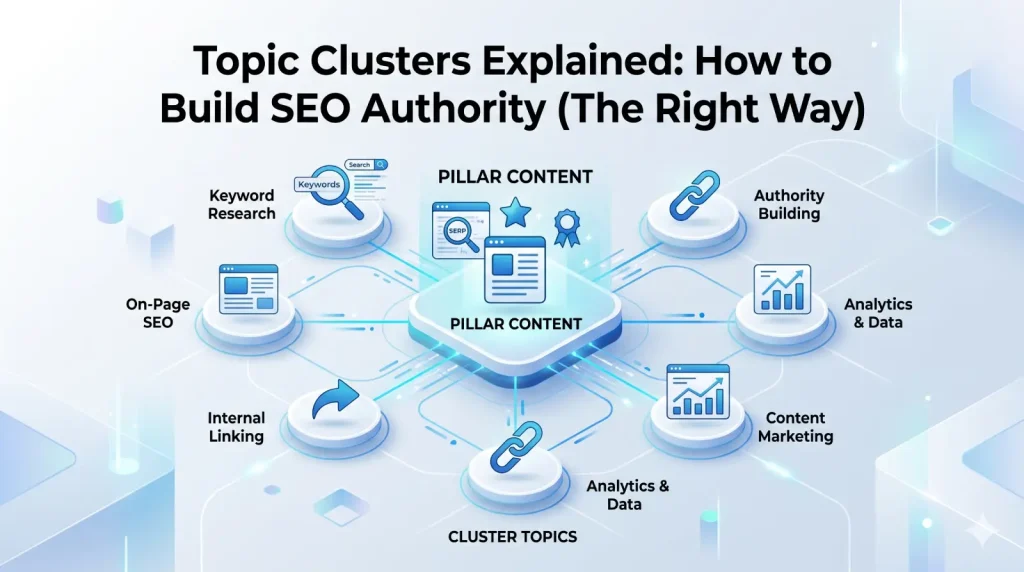
At its core, a topic cluster is a group of interlinked content pieces that all revolve around one broad subject.
Think of it like a solar system. You have one big ‘sun’ — that is your pillar page — and multiple smaller ‘planets’ orbiting around it. Those planets are your cluster content (also called supporting articles or subtopic pages). Everything connects back to the centre through internal links.
This structure does two things at once:
- It tells Google: ‘This website really knows what it is talking about on this subject.’
- It gives your readers a clear, organised path through complex information.
Before topic clusters became popular, most SEO strategies were keyword-first. You would find a keyword, write a post, publish, and repeat. The problem? Those posts often competed with each other or existed in isolation — invisible to both search engines and users.
The topic cluster model (popularised by HubSpot around 2017) flipped that approach on its head. Instead of building a pile of unrelated content, you build a web of authority.
The Three Parts of a Topic Cluster
1. The Pillar Page
Your pillar page is the backbone of the entire cluster. It covers a broad topic comprehensively — not necessarily in exhaustive detail, but enough to give readers a solid overview.
For example, if you run an SEO agency, a pillar page might be:
“The Complete Guide to SEO for Small Businesses”
This page should:
- Target a high-volume, competitive keyword
- Be long-form (typically 2,000 to 5,000+ words)
- Touch on all the major subtopics within that subject
- Link out to all supporting cluster articles
- Be kept evergreen and updated regularly
Think of it as the hub your whole cluster is built around.
2. The Cluster Content (Supporting Articles)
These are the individual blog posts or articles that dive deeper into specific subtopics from your pillar page. Using the same SEO example, cluster content might include:
- How to Do Keyword Research for a Local Business
- On-Page SEO Checklist: 15 Elements You Should Not Ignore
- What Is Domain Authority and Why Does It Matter?
- Technical SEO for Beginners: A Simple Starter Guide
Each of these links back to the pillar page — and ideally, they link to each other where relevant. That web of links is what gives the cluster its structural power.
3. Internal Links (The Connective Tissue)
Internal links are what tie the whole system together. Without them, your pillar page and cluster content are just individual posts sitting next to each other. With them, you create a network of context that search engines can follow and understand.
A good internal linking strategy:
- Uses descriptive anchor text (not ‘click here’)
- Links cluster articles back to the pillar page
- Creates cross-links between related cluster articles where it makes sense
- Avoids linking just for the sake of it — relevance matters
Why Topic Clusters Actually Work (The SEO Logic Behind It)
Google does not just rank individual pages anymore. It tries to understand the topical authority of an entire website. Topical authority basically means: ‘Does this site consistently demonstrate expertise on a given subject?’
When you build a topic cluster, you give Google a clear signal that your website owns a subject matter. You are not just writing one article about keyword research — you have ten interconnected articles about it, all reinforcing each other.
This helps in several ways:
Stronger link equity distribution. When your pillar page earns backlinks, that authority flows through internal links to your cluster content, giving those pages a ranking boost they might not have earned on their own.
Reduced keyword cannibalization. Ever written two posts that ended up competing with each other in search results? Clusters help you avoid that by clearly defining the scope of each piece of content.
Better user engagement signals. When readers can easily navigate from one related article to the next, they spend more time on your site. Lower bounce rates and longer session durations are positive signals to search engines.
Faster indexing for new content. When you publish a new cluster article and link it from your pillar page and other cluster content, Googlebot discovers it faster.
How to Build a Topic Cluster: A Practical Step-by-Step Process
Step 1: Choose Your Core Topic
Start with a broad topic that is central to your business or expertise — something you genuinely want to be known for. It should be:
- Relevant to your target audience’s needs
- Broad enough to spawn 8 to 15+ subtopics
- Competitive enough that ranking for it would actually matter for your business
For a digital marketing agency, core topics might be: SEO, Content Marketing, PPC Advertising, Social Media Strategy, Email Marketing, or Website Analytics. Do not try to build clusters around every topic at once. Pick one or two to start and go deep.
Step 2: Map Out Your Subtopics
Once you have your core topic, brainstorm all the questions, problems, and angles your audience might search for related to it. A few methods that work well:
- Google’s ‘People Also Ask’ box — type your core topic and see what Google surfaces
- Answer the Public — enter your topic and get a visual map of questions
- Competitor research — look at what is ranking in your niche and find gaps
- Keyword tools (Ahrefs, SEMrush, Ubersuggest) — filter for long-tail variations
Aim for 8 to 15 subtopics. Each one becomes a cluster article.
Step 3: Create (or Identify) Your Pillar Page
If you already have existing content on your core topic, that might become your pillar page with some expansion and restructuring. If not, create one from scratch.
Your pillar page should briefly cover every subtopic in your cluster — think of it as a table of contents come to life. Each section should link to the dedicated cluster article that covers that subtopic in depth.
Step 4: Produce Your Cluster Content
Now write (or repurpose) each of the subtopic articles. These should:
- Target more specific, long-tail keywords
- Be thorough but focused — do not try to cover everything in each post
- Include a clear link back to the pillar page
- Reference related cluster content where relevant
If you already have blog posts that fit into this cluster structure, do not delete them — update them, optimise them, and link them into your new cluster architecture.
Step 5: Build Your Internal Links
Go through every cluster article and make sure:
- There is a natural link back to the pillar page
- Where it makes sense, cluster articles link to each other
- The pillar page links to all cluster articles
Use keyword-rich anchor text where it fits naturally. Do not force it — Google has gotten pretty good at detecting unnatural link patterns.
Step 6: Monitor, Update, and Expand
Topic clusters are not a one-time project. Once your cluster is live:
- Track rankings for both pillar and cluster pages
- Update content when it becomes outdated
- Add new cluster articles as new subtopics emerge
- Watch for content gaps that competitors are filling
Real-World Example: Topic Cluster for an SEO Agency
Here is exactly how this might look for a business like yours.
Core Topic: SEO Strategy
Pillar Page: The Ultimate SEO Strategy Guide: How to Rank Higher
Cluster Articles:
- What Is Keyword Research and How to Do It Step by Step
- On-Page SEO: The 12 Elements That Actually Impact Rankings
- Technical SEO Audit: How to Find and Fix Hidden Website Issues
- How to Build Backlinks That Google Actually Values
- Local SEO Guide: How to Rank for ‘Near Me’ Searches
- Topic Clusters Explained: How to Build SEO Authority (you are reading a cluster article right now!)
- How Long Does SEO Take? Realistic Timelines Explained
- Core Web Vitals: What They Are and Why They Matter for SEO
- SEO for New Websites: Where to Start When You Have Zero Traffic
Each of these articles links back to the main pillar page. The pillar page links to all of them. And where relevant, they link to each other. That is a topic cluster in action.
Common Mistakes People Make With Topic Clusters
Mistake #1: Creating the cluster but skipping the internal links
This is shockingly common. People put a lot of effort into writing great content, then forget to actually link everything together. Without those internal links, you do not have a cluster — you just have a bunch of articles.
Mistake #2: Making the pillar page too thin
Your pillar page is supposed to be authoritative. If it is just 500 words with a list of links, it will not hold up. Invest in making it genuinely useful and comprehensive.
Mistake #3: Choosing topics that are too narrow
A topic like ‘how to use the alt text field in WordPress’ is a great cluster article — but it is too narrow to build a whole cluster around. Make sure your core topic is broad enough to support multiple layers of content.
Mistake #4: Building clusters on topics you do not actually know
Google’s helpful content system is increasingly focused on real expertise and first-hand experience. Building a cluster on a topic you have no genuine knowledge of is a short-term play at best.
Mistake #5: Building too many clusters at once
Depth beats breadth in SEO. One well-developed cluster of 12 articles will outperform four half-built clusters of three articles each. Go deep before you go wide.
How Long Does It Take to See Results?
This is the question everyone asks, and the honest answer is: usually 3 to 6 months for meaningful movement.
When you first launch a cluster, Google needs time to crawl everything, understand the relationships between pages, and re-evaluate your site’s authority on that topic. If your site is newer or has lower domain authority, it might take longer.
What you will often notice is a gradual pattern:
- Your cluster articles start picking up impressions in Google Search Console
- Long-tail cluster pages start ranking on pages 2 to 3
- Your pillar page’s rankings improve as cluster content earns engagement
- Over time, the whole cluster lifts together
The compounding effect is real — and it is one of the most satisfying things to watch in SEO.
Topic Clusters vs. Traditional Keyword-Based SEO: What’s the Difference?
| Traditional Approach | Topic Cluster Approach | |
| Strategy | Target individual keywords | Build authority around a topic |
| Content relationship | Articles exist in isolation | Articles support each other |
| Internal linking | Ad hoc, inconsistent | Intentional, systematic |
| Cannibalization | Common problem | Largely avoided |
| Long-term outcome | Diminishing returns | Compounding authority |
| Google alignment | Keyword matching | Topical relevance signals |
The keyword-first approach is not wrong — keywords still matter enormously. But the topic cluster approach uses keywords as tools within a larger strategic framework, rather than treating each keyword as a standalone goal.
Is Your Website Ready to Start Building Topic Clusters?
Before you dive in, here is a quick readiness check:
- Do you have a clear idea of 2 to 3 core topics that matter to your business?
- Do you have the capacity to produce 8 to 15 pieces of quality content per cluster?
- Are you willing to update and maintain this content over time?
- Do you have a way to track rankings and traffic at the page level?
If you checked most of those boxes, you are ready to start.
If not — that is okay. Start by auditing the content you already have. You might find that you are closer to a cluster than you think. Many businesses have scattered articles on related topics that just need to be connected and expanded.
Final Thoughts: Authority Is Built, Not Stumbled Upon
There is no shortcut to becoming the go-to resource in your niche. But there is a system — and topic clusters are that system.
When you organise your content intentionally, link it together strategically, and commit to covering a subject with real depth, search engines start to see your website the way you want your audience to see it: as a trusted, authoritative source.
That reputation compounds. The more you build it, the harder it becomes for competitors to displace you.
So if you have been spinning your wheels with random blog posts and scattered keywords, the topic cluster model is your reset button.
Start with one topic. Build it properly. Watch what happens.
Frequently Asked Questions About Topic Clusters
How many articles do I need for a topic cluster?
There is no strict rule, but most effective clusters have between 8 and 20 supporting articles alongside the pillar page. The right number depends on how broad your core topic is and how many subtopics genuinely deserve their own dedicated content.
Can I use existing content in a topic cluster?
Absolutely — in fact, you should. Audit your existing content first. Update it, fill in gaps, and link everything together before creating new content.
What is the difference between a pillar page and a regular blog post?
A blog post typically targets a specific keyword and covers a focused topic. A pillar page covers a broad subject comprehensively and is designed to link out to all related subtopic content. Pillar pages are usually longer, more evergreen, and more intentionally structured.
Do topic clusters work for local SEO?
Yes, with some adaptation. For local SEO, your clusters might focus on location-specific topics or service-based subtopics relevant to your area. The structural logic remains the same.
Should I build one cluster or multiple at once?
Start with one and build it fully before expanding. Depth of authority on one topic will do more for your SEO than shallow coverage across many topics.
Need help building a topic cluster strategy for your website? Our SEO team works with businesses to create content architectures that drive long-term organic growth — not just short-term traffic spikes. Get in touch with us today.