
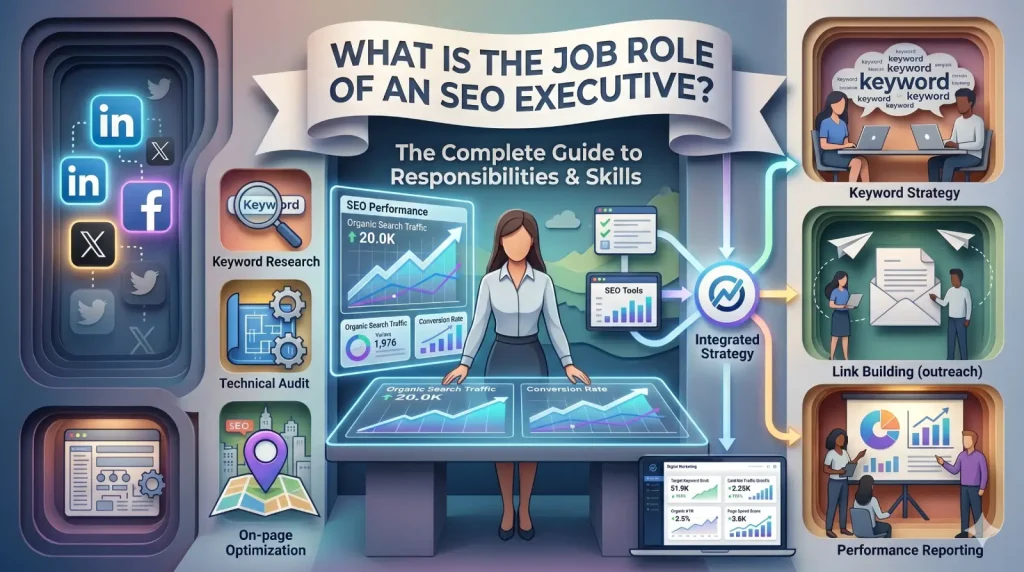
| Quick Answer: An SEO Executive is the hands-on professional responsible for improving a website’s organic visibility through technical optimization, keyword research, content strategy, and link building — while increasingly adapting to AI-driven platforms like Google’s AI Overviews, ChatGPT, and Perplexity. |
If your business relies on organic search traffic — and it should — the person making it happen is likely an SEO Executive. They’re the ones combing through keyword data at 9 a.m., fixing broken links at noon, and reviewing ranking reports before the day ends. It’s not always a glamorous role, but it’s one of the most strategically critical positions inside any digital marketing services team.
In 2026, the SEO Executive’s responsibilities have expanded dramatically. Beyond traditional search engine optimization, they now navigate Answer Engine Optimization (AEO), Generative Engine Optimization (GEO), and LLM visibility — a trio of disciplines that are reshaping how brands get discovered online.
Why SEO Still Matters (The Data Speaks)
Before diving into responsibilities, let’s look at what the numbers say about the state of search in 2025–2026:
| Stat | Figure | Source |
| #1 organic result vs. #10 position | 10× more clicks | Backlinko |
| Google searches ending without a click (AI summaries) | 60% | Bain, 2025 |
| Brand searches triggering Google AI Overviews | 89% | Goodfirms, 2026 |
| More organic clicks when cited inside AI Overviews | +35% | Seer Interactive |
| SEO pros with active LLM/GEO strategies | 43% | Goodfirms, 2026 |
| More AI search traffic for early AEO adopters | 3.4× | TNGShopper, 2025 |
| Keyword-rich URLs vs. non-keyword URLs (CTR boost) | +45% | Backlinko |
The takeaway is clear: organic search is evolving fast. An SEO Executive who only optimizes for the traditional ’10 blue links’ is already working with an incomplete playbook.
Core Responsibilities of an SEO Executive
1. Keyword Research & Competitive Analysis
Everything in SEO starts with understanding what people actually type into search engines. An SEO Executive uses tools like SEMrush, Ahrefs, and Google Keyword Planner to:
- Identify high-volume, low-competition keywords for blog posts and landing pages
- Map keywords to the buyer’s journey (awareness, consideration, decision)
- Analyze competitor keyword gaps and capitalize on them
- Cluster related terms to build topic authority across the site
- Track keyword intent shifts as AI-generated answers change search behavior
| CTR Insight: Including a keyword in a URL boosts click-through rate by up to 45% compared to URLs without relevant keywords (Backlinko). Search terms that are 10–15 words long receive 1.76× more clicks than single-word queries. |
2. On-Page SEO Optimization
Once keywords are mapped, the SEO Executive ensures every page is structured to rank. This includes:
- Writing compelling title tags and meta descriptions that drive CTR
- Optimizing heading structure (H1, H2, H3) for clarity and keyword relevance
- Building a clean internal linking architecture to distribute page authority
- Optimizing images with descriptive alt text and compressing file sizes
- Implementing schema markup — websites with structured data see up to 40% higher CTR (TNGShopper, 2025)
3. Technical SEO
Think of technical SEO as the plumbing of a website. Users don’t see it, but everything depends on it running smoothly. A skilled SEO Executive will regularly:
- Audit crawl errors, 404 pages, and broken redirect chains via Google Search Console
- Monitor Core Web Vitals (LCP, INP, CLS) for page experience signals
- Maintain clean XML sitemaps and robots.txt files
- Fix duplicate content issues using canonical tags
- Ensure the site is fully mobile-optimized — 45% of web traffic now comes from mobile devices (MobiLoud, 2025)
4. Content Strategy & Optimization
The SEO Executive bridges the gap between search intent and content creation. Rather than writing every piece themselves, they:
- Develop SEO content briefs for writers and designers
- Optimize existing pages to keep them relevant and competitive
- Identify content gaps by comparing the site against top-ranking competitors
- Ensure content follows E-E-A-T principles (Experience, Expertise, Authoritativeness, Trustworthiness)
- Format content so it is easily extractable by AI systems — a key requirement for AEO and GEO
5. Link Building & Digital PR
Backlinks remain one of Google’s most powerful ranking signals. An SEO Executive:
- Identifies high-authority sites for outreach and guest posting
- Monitors and disavows toxic backlinks that could trigger search penalties
- Builds relationships with publishers and digital PR contacts
- Focuses on quality over quantity — not all backlinks carry equal weight
6. Reporting & Performance Tracking
You can’t improve what you don’t measure. SEO Executives track performance through:
- Google Analytics 4 (GA4) for organic traffic, engagement rates, and conversions
- Google Search Console for impressions, CTR, and average position
- Rank tracking tools like SEMrush or Ahrefs for keyword movement
- Presenting monthly performance reports with insights and actionable recommendations
The New Frontier: AEO, GEO & LLM Optimization
This is where the modern SEO Executive truly differentiates themselves. Traditional search is being disrupted at speed, and SEO services teams that ignore AI-driven channels are leaving visibility on the table.
| Discipline | What It Means | Why It Matters Now |
| AEO Answer Engine Optimization | Optimizing content to appear as direct answers in AI-generated summaries (Google AI Overviews, featured snippets) | Early AEO adopters capture 3.4× more traffic. Brands cited in AI Overviews receive 35% more organic clicks. |
| GEO Generative Engine Optimization | Structuring content to be cited by AI platforms like ChatGPT, Perplexity, and Google AI Mode | LLMs cite only 2–7 domains per response. Mid-market brands now allocate $75K–$150K annually to GEO. |
| LLM SEO Large Language Model Visibility | Ensuring your brand appears in answers generated by large language models across AI chatbots | ChatGPT is the 4th most visited site globally with 400M weekly users, driving 77–87% of all AI referral traffic. |
“Good SEO is good GEO.” — Google’s Danny Sullivan, 2025. Strong technical foundations, authoritative content, and structured data power visibility across both traditional search and AI-generated answers.
Key Skills an SEO Executive Must Have
| Skill Area | Specific Competencies | Priority |
| Analytics & Data | Google Analytics 4, Search Console, rank tracking tools | Essential |
| Technical SEO | Site audits (Screaming Frog), Core Web Vitals, structured data | Essential |
| Keyword Research | Ahrefs, SEMrush, Google Keyword Planner, intent mapping | Essential |
| Content Strategy | Brief writing, E-E-A-T optimization, topic clustering | Essential |
| AI / AEO / GEO | Schema markup, answer optimization, LLM citation strategy | High Priority |
| Link Building | Outreach, digital PR, backlink analysis and monitoring | High Priority |
| HTML/CSS Basics | Reading source code, meta tag editing, page structure | Helpful |
Career Path & Salary Benchmarks
The SEO career ladder is well-defined, and the earning potential has grown alongside the role’s strategic importance:
- SEO Intern — Learning the fundamentals of keyword research and on-page optimization
- SEO Executive — Hands-on execution of campaigns, audits, and reporting
- SEO Analyst / Specialist — Deeper data analysis and strategy development
- SEO Strategist / Manager — Leading campaigns, managing teams, overseeing digital marketing strategy
- Head of SEO / SEO Director — Setting the search vision and aligning with business objectives
In terms of compensation, SEO is one of the more lucrative tracks within digital marketing services. According to a 2025 salary analysis, the SEO executive-level role commands a median income of $116,502, with top earners reaching $239,725 annually (Inbound Blogging, 2025). Entry-level SEO positions average around $74,795 per year.
Frequently Asked Questions (FAQs)
Q1. What does an SEO Executive do on a daily basis?
A typical day includes reviewing Search Console data, optimizing page metadata, checking keyword rankings, conducting site audits, and collaborating with content and development teams. Monitoring brand visibility in AI Overviews and LLM responses is increasingly part of the daily workflow.
Q2. Is SEO still a good career in 2026?
Absolutely. AI is creating demand for more sophisticated SEO professionals who understand AEO, GEO, and LLM optimization. Over 86% of SEO professionals now incorporate AI tools in their campaign strategies (SEO Clarity, 2025), making it a future-proof skill set.
Q3. What is the difference between an SEO Executive and an SEO Manager?
An SEO Executive is hands-on — executing keyword research, content optimization, link building, and technical fixes. An SEO Manager oversees strategy, manages a team, sets KPIs, and coordinates with senior leadership. The Manager role requires more leadership experience and budget responsibility.
Q4. What tools does an SEO Executive use?
The most common stack includes Google Search Console, Google Analytics 4, Ahrefs or SEMrush for keyword and backlink research, Screaming Frog for technical audits, and SurferSEO or Frase for content optimization. AI tools like ChatGPT are increasingly used for research and brief writing.
Q5. How long does SEO take to show results?
Typically 3–6 months for meaningful organic ranking improvements, depending on domain authority, competition, and execution consistency. Technical fixes can have faster impact, while content-driven strategies compound over time.
Q6. What is AEO and why should SEO Executives care?
AEO (Answer Engine Optimization) is the practice of optimizing content to appear as direct answers in AI-powered search results. With 60% of Google searches now ending without a click, getting featured inside AI-generated answers is often more valuable than ranking #1 in traditional results.
Q7. Do SEO Executives need coding skills?
Basic HTML and CSS knowledge is helpful — it allows SEO Executives to read source code and fix meta tags without waiting on developers. However, it is not a hard requirement for entry-level positions. Understanding technical concepts matters more than writing code from scratch.
| Ready to grow your organic presence? Our digital marketing services team includes experienced SEO executives who understand both traditional search and the new world of AEO, GEO, and LLM visibility. Contact us today for a free SEO audit. |